Electronic billing 2027: the essentials for physiotherapists.
On 1 January 2027, physiotherapists in Belgium switch to the four MyCareNet services. What changes compared with paper, what you need, and why it mostly saves you time.
For physiotherapists in Belgium. Elsewhere, Synkro Clinic is used without the billing module.
The essentials, in four points.
When
1 January 2027
Until then, paper is still allowed and you can alternate. After that, electronic becomes the rule.
What
Four MyCareNet services
Member Data, eAgreement, eAttest and eFact, used from certified software.
What you need
An eHealth certificate, certified software
You create the certificate once, with your identity card. The software does the rest.
The exceptions
Rare, and set by INAMI-RIZIV
67 or older on 1 January 2027; working in a hospital that bills for you; billing outside the practice that is technically impossible; force majeure.
The INAMI-RIZIV textA simple circuit, between you and the fund.
MyCareNet is the health insurance funds' secure platform, run by the National Intermutualist College (NIC-CIN). Your software connects to it on your behalf, thanks to your eHealth certificate. Each of the four services is an exchange with the patient's fund: you send, the answer comes back into your software.
You
at the practice, during or after the session
Your certified software
Synkro Clinic prepares and sends
MyCareNet
the funds' platform
The patient's fund
checks, decides, refunds, pays
What you already do, electronically.
The four services add no task: they replace things you do on paper today.
Check the patient's cover
Today : You rely on what the patient says, or check separately.
From 1 January 2027 : Member Data: their fund's answer, before the session.
Get a treatment approved (Fa, Fb, E)
Today : A notification or request form for the medical adviser.
From 1 January 2027 : eAgreement: the request leaves from the software, the decision comes back there.
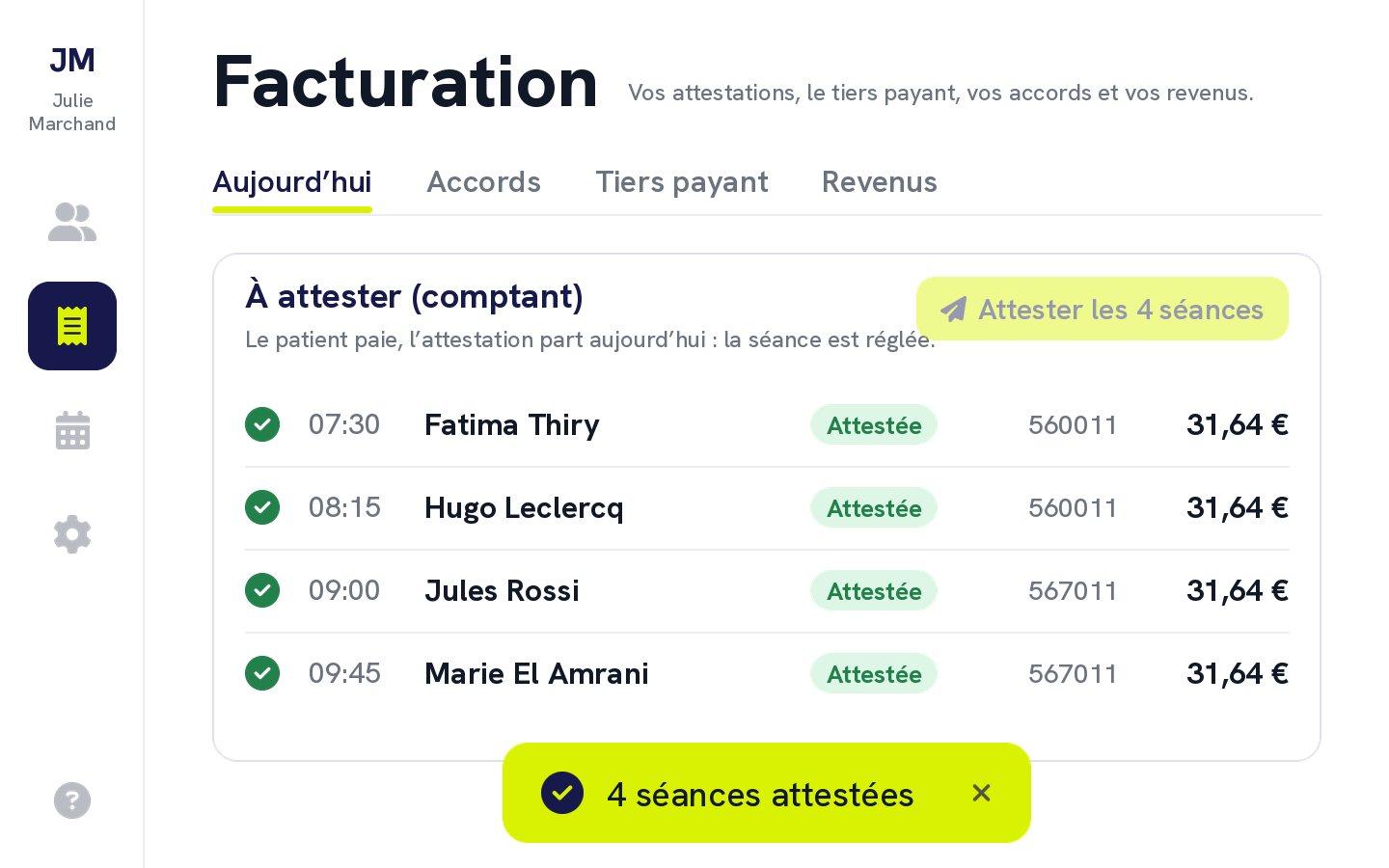
A session paid on the spot
Today : A paper attestation that the patient hands in to their fund.
From 1 January 2027 : eAttest: the attestation leaves the same day; the patient gets a supporting document.
Third-party payment
Today : Billing each fund, on paper or already electronically.
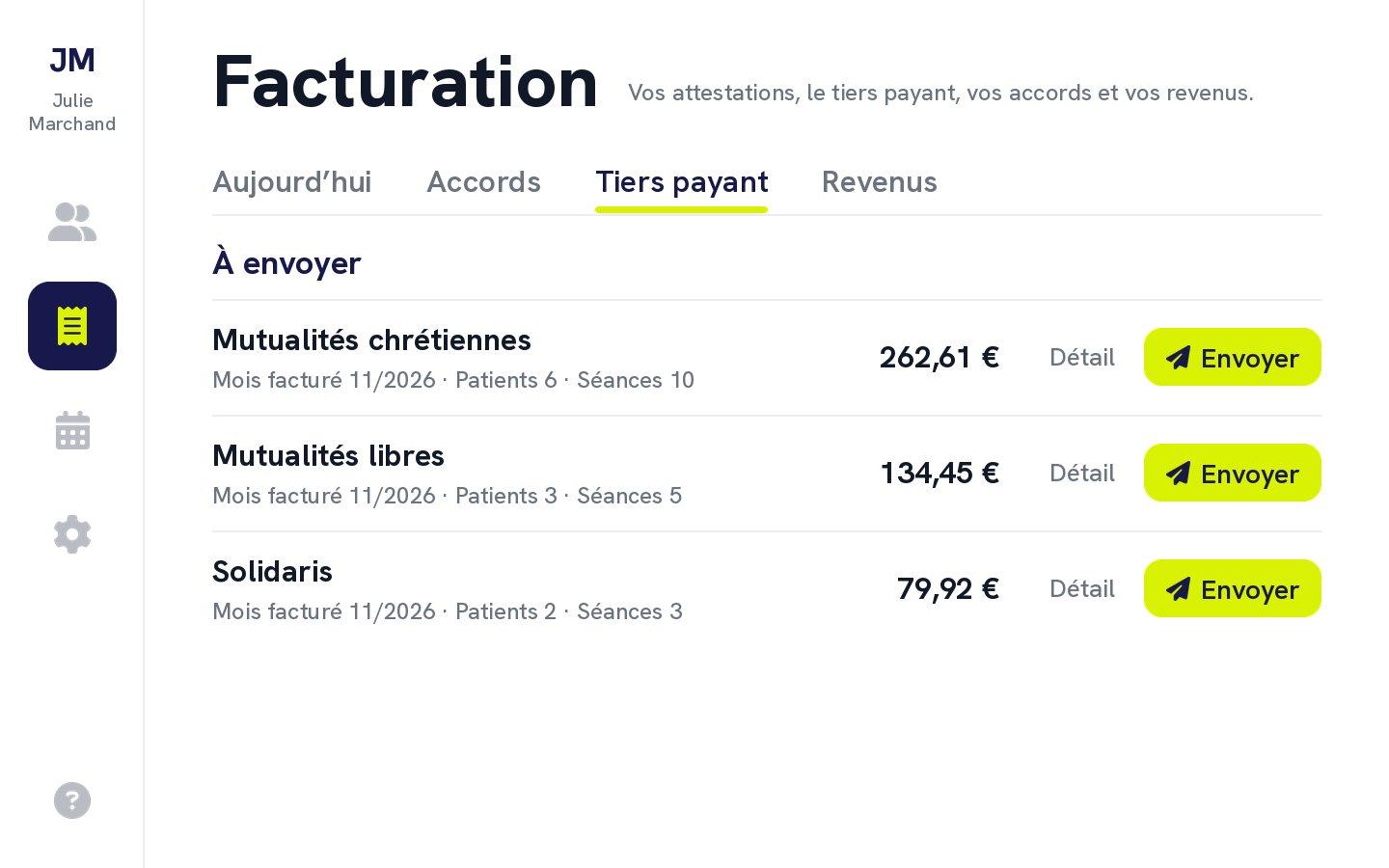
From 1 January 2027 : eFact: one submission per fund, paid within two weeks.
Paper does not disappear entirely.
Until 31 December 2026, you can still alternate. After that, keep a few paper attestations (ordered through Medattest) for the exceptions. Never both for the same session.
What each service is for, and what you gain.
Member Data
The patient's fund, checked.
- What it is for
It gives the patient's insurance status: covered or not, their scheme, whether third-party payment is possible. To check before starting a treatment.
- What you gain
Fewer rejections afterwards: you know how to bill before the session.
- In Synkro Clinic
One click on « Check » in the record. The answer stays there, dated.
eAgreement
Agreements, without paper forms.
- What it is for
It sends notifications and agreement requests to the fund, and brings back the medical adviser's decision. It is also required to attest electronically.
- What you gain
Every request is followed up, and the decision arrives where you work.
- In Synkro Clinic
Notification or request, it leaves from the patient's record, with your report when it is required.
eAttest
The paid session, attested the same day.
- What it is for
For sessions paid on the spot: the electronic attestation goes to the fund on the date of the session, and the patient receives a supporting document.
- What you gain
No more attestations to fill in by hand. Your patient is refunded on their bank account, without handing in anything.
- In Synkro Clinic
From the calendar: « Completed and attested » as the session ends. Or in the evening, the whole day at once. The supporting document is ready.
eFact
Third-party payment, sent per fund.
- What it is for
Billing under third-party payment: you send the fund's share, the patient only pays their own. Sending at the end of the day is recommended.
- What you gain
The fund pays you within two weeks of receiving the data.
- In Synkro Clinic
One submission per fund. Every rejection says who needs to act, its code and what to do. What each fund still owes you stays visible.
An obligation, and above all time saved.
Built into your day, electronic billing becomes a routine of a few seconds. Synkro Clinic was designed for that: every screen shows what is left to do.
- Designed for your day
The calendar, the session, the attestation: one thread, from morning to evening.
- Pre-filled documents
The patient's supporting document, the report attached to the agreement request, the export for your accountant.
- Your patients, carried over
An Excel or CSV export from your previous software is enough: your patients are there, without duplicates.
- Rejections explained
Every rejection says plainly who needs to act and how to fix it.
- Your money, tracked
Income month by month, unpaid amounts and reminders, from patients and from funds.
- The clinical side too
Assessments, tests and questionnaires, exercises and patient follow-up, in the same software.
Your list for 1 January.
02
Your eHealth certificate
In four steps, just below. Already have one? Keep it and upload the same file.
The four steps03
Software certified for the four services
Synkro Clinic is certified for Member Data and eAgreement; certification for eAttest and eFact is in progress. Any software can be checked on the official list.
The official NIC-CIN list04
Your patients in the software
Export them from your previous software as Excel or CSV: Synkro Clinic imports them.
eID card reading
Synkro can read your patient’s electronic ID card and fill in their record automatically: national number, first name, last name, date of birth, sex and address. In seconds, with no risk of a typo.
01
Install the official Belgian eID software
Developed by the Belgian government, this software lets your computer talk to the ID card.
Download from eid.belgium.be02
Install Synkro eID Bridge
This small Synkro app links your card reader to the web app. It must stay open while you use Synkro.
03
Plug in a USB card reader
Any PC/SC-compatible reader works. Common models cost €15–25 and are available on Amazon or in computer shops.
Synkro eID Bridge must stay open in the background during your consultation for card reading to work. It uses almost no resources and sends no data outside your machine.
The full eID reader guideYour eHealth certificate, in four steps.
It lets Synkro Clinic use MyCareNet on your behalf. You create it once, with your identity card, and it is valid for three years.
Before you start: the official eID software, a card reader, your identity card and its PIN code. Install the eID software
01
Download the tool
eHealth's official program, ready to open on Mac and Windows: nothing else to install.
02
Make the request
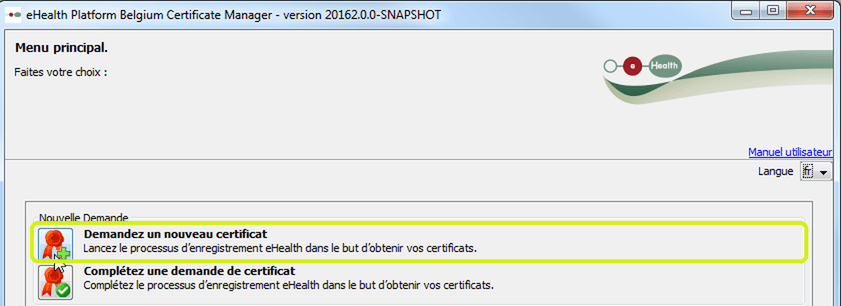
Choose to request a new certificate, insert your card and type your PIN code. Then choose a password and write it down right away: it cannot be recovered.
03The step people forget
Come back to finish
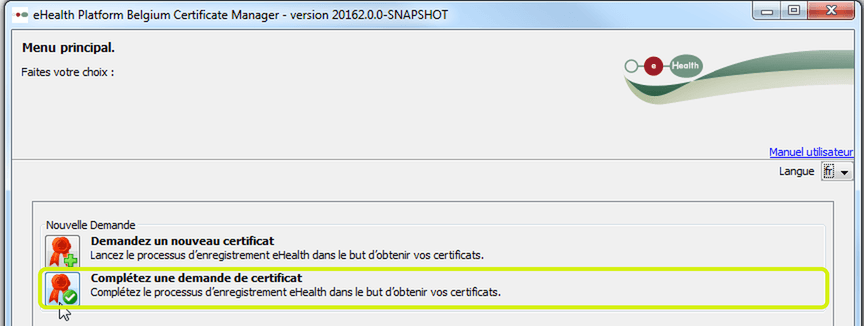
eHealth validates your request within a few days and sends you two e-mails. On the second one, reopen the tool on the same computer: choose to complete a certificate request, type your password, then install your certificate. Without this step, there is no certificate.
04
Upload it to Synkro Clinic
Settings › eHealth certificate: the .p12 file (in the ehealth › keystore folder of your home folder), then its password. That's it.
Already have an eHealth certificate? Keep it and upload that same file to Synkro Clinic (step 4). Do not create a second one: your current software could stop working.
Screenshots: official eHealth platform manual (French version).
The full guide, and help if something goes wrongWhat physiotherapists ask us.
Is paper still possible after 1 January 2027?
Only in the exceptions: 67 or older on 1 January 2027, working in a hospital that bills for you, billing outside the practice that is technically impossible, force majeure. So keep a few paper attestations, ordered through Medattest. Outside these cases, no individual exemption.
And until then?
Until 31 December 2026, paper is still allowed and you can alternate: one session on paper, another electronically, never both for the same one. A good time to find your feet.
What does eAttest change for my patient?
They receive a supporting document and no longer have an attestation to hand in to their fund: the fund refunds them directly on their bank account.
When am I paid under third-party payment?
The fund pays within two weeks of receiving your data. Synkro Clinic shows you what each fund still owes you.
What if the fund rejects a session?
Synkro Clinic tells you plainly who needs to act (the fund, MyCareNet or us), the rejection code and what to do to fix it.
I already have an eHealth certificate with my current software.
Keep it: upload that same file to Synkro Clinic. No need to create a second one.
I work in a group practice.
The obligation applies to each physiotherapist. In Synkro Clinic, everyone bills under their own INAMI-RIZIV number, and the price drops from the practice's second practitioner.
I don't work in Belgium.
MyCareNet only concerns Belgium. Synkro Clinic works everywhere, without the billing module: records, assessments, exercises, follow-up and movement analysis.
How much does Synkro Clinic with billing cost?
The price is on the Pricing page, VAT included and with no commitment. You can try it free for 15 days, no credit card needed.
Sources
The rules on this page come from official sources (in French and Dutch). Last checked: 22 November 2026.
Try it with your own patients.
15 days to make up your mind, no credit card. We can also walk you through it live, on a real case.
No commitment · Your data stays exportable